Chess is a two-player strategy board game played on a chessboard, a checkered gameboard with 64 squares arranged in an 8×8 grid. The game is played by millions of people worldwide. Chess is believed to be derived from the Indian game chaturanga some time before the 7th century. Chaturanga is also the likely ancestor of the Eastern strategy games xiangqi, janggi, and shogi. Chess reached Europe by the 9th century, due to the Umayyad conquest of Hispania. The pieces assumed their current powers in Spain in the late 15th century with the introduction of “Mad Queen Chess”; the modern rules were standardized in the 19th century.
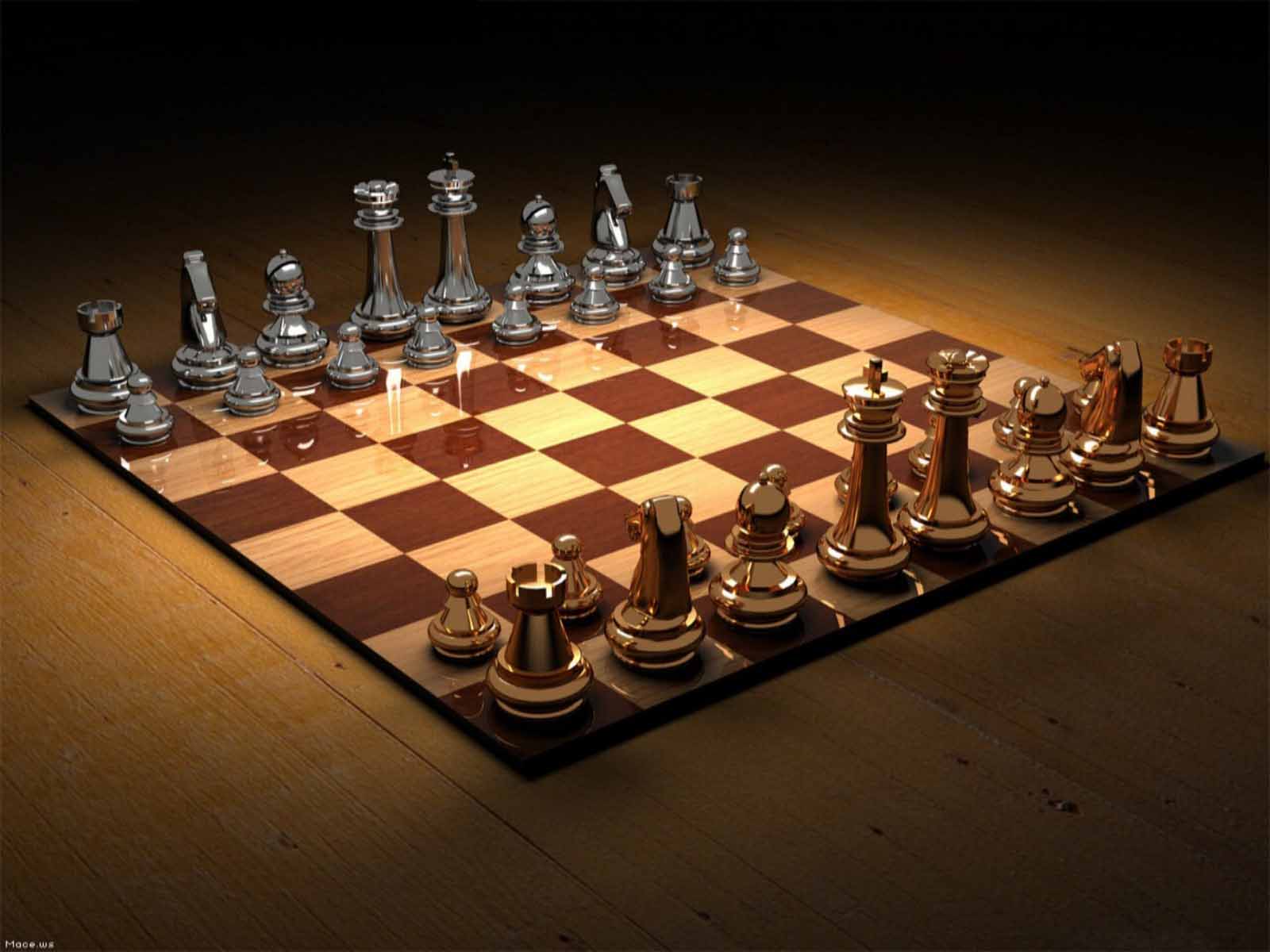
Basically, there are three parts in a full chess game :
- Chess Openings : The first few moves in the chess opening lays the foundation for every chess game. Most of the chess openings have been named and analyzed for hundreds of years. It is important if you want to be successful in chess to be familiar with some of the most popular openings and understand the theory behind the moves. Many beginners ask what they should study first. While it’s important to understand concepts more than memorizing moves of a particular opening there are a few specific openings that all chess players should start with because they are so widely played. For white, a player should first learn the King’s Gambit, Queen’s Gambit, Ruy Lopez and the English. For black, a player should first learn the Sicilian Defense, French Defense, Scandinavian, and the Slav. It’s important for any chess player to figure out what type of strategy they like to play. Each opening has a very different play style. Once someone determines what type of game they like to play they can then learn other openings that lead to those type of games.
- The Middle game : The middlegame in chess refers to the portion of the game in between the opening and the endgame. There is no clear line between the opening and middlegame, and between the middlegame and endgame. In modern chess, the moves that make up an opening blend into the middlegame, so there is no sharp divide. Simply put, the middle game begins when both players have completed the development of all or most of their pieces and the king has been brought to relative safety. However, at master level, the opening analysis may go well into the middlegame. Likewise, the middlegame blends into the endgame. There are differing opinions and criteria for when the middlegame ends and the endgame starts (see the start of the endgame). Factors such as control of the center are less important in the endgame than the middlegame. In endgames the number of pieces and pawns is much reduced, though even after queens are traded, one may talk about a “middlegame without queens.” The endgame is often said to begin when the kings can safely play an active role. Theory on the middlegame is less developed than the opening or endgames. Since middlegame positions are unique from game to game, memorization of theoretical variations is not possible as it is in the opening. Likewise, there are usually too many pieces on the board for theoretical positions to be completely analyzed as can be done in the simpler endgames.
- The End game : The most important part of any chess game is the end game. You can have an overwhelming advantage but lose the game because of poor end game tactics. You can also be down material, with all hope lost, and come back and win with great end game tactics. There are many different concepts that every chess player should be aware of for the end game. Usually in the endgame, the stronger side should try to exchange pieces, while avoiding the exchange of pawns. This generally makes it easier to convert a material advantage into a won game. The defending side should strive for the opposite. Chess players classify endgames according to the type of pieces that remain.
.
.
Rules of Chess
The rules of chess (also known as the laws of chess) are rules governing the play of the game of chess. While the exact origins of chess are unclear, modern rules first took form during the Middle Ages. The rules continued to be slightly modified until the early 19th century, when they reached essentially their current form. The rules also varied somewhat from place to place. Today, the standard rules are set by FIDE (Fédération Internationale des Échecs), the international governing body for chess. Slight modifications are made by some national organizations for their own purposes. There are variations of the rules for fast chess, correspondence chess, online chess, and Chess360.
Chess is a two-player board game utilizing a chessboard and sixteen pieces of six types for each player. Each type of piece moves in a distinct way. The goal of the game is to checkmate (threaten with inescapable capture) the opponent’s king. Games do not necessarily end in checkmate; players often resign if they believe they will lose. A game can also end in a draw in several ways.
Besides the basic moves of the pieces, rules also govern the equipment used, time control, conduct and ethics of players, accommodations for physically challenged players, and recording of moves using chess notation. Procedures for resolving irregularities that can occur during a game are provided as well.
Initial Setup
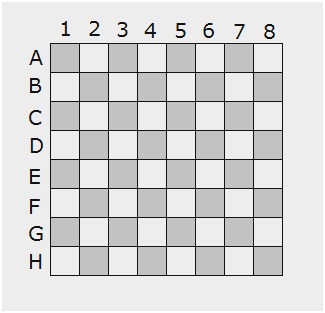
Chess is played on a chessboard, a square board divided into 64 squares (eight-by-eight) of alternating color, which is similar to that used in draughts (checkers) (FIDE 2008). No matter what the actual colors of the board, the lighter-colored squares are called “light” or “white”, and the darker-colored squares are called “dark” or “black”. Sixteen “white” and sixteen “black” pieces are placed on the board at the beginning of the game. The board is placed so that a white square is in each player’s near-right corner. Horizontal rows are called ranks and vertical rows are called files.
Each player controls sixteen pieces:
| Piece | King | Queen | Rook | Bishop | Knight | Pawn |
|---|---|---|---|---|---|---|
| Number | 1 | 1 | 2 | 2 | 2 | 8 |
At the beginning of the game, the pieces are arranged as shown in the diagram: for each side one king, one queen, two rooks, two bishops, two knights, and eight pawns. The pieces are placed, one on a square, as follows:
- The rooks are placed on the outside corners, right and left edge.
- The knights are placed immediately inside of the rooks.
- The bishops are placed immediately inside of the knights.
- The queen is placed on the central square of the same color of that of the player: white queen on the white square and black queen on the black square.
- The king takes the vacant spot next to the queen.
- The pawns are placed one square in front of all of the other pieces.
Indian Chess Champion- Viswanathan Anand Playing Chess

 Harshit's Blog